Research Paper
Alpha Optimus Research Division
January 2024
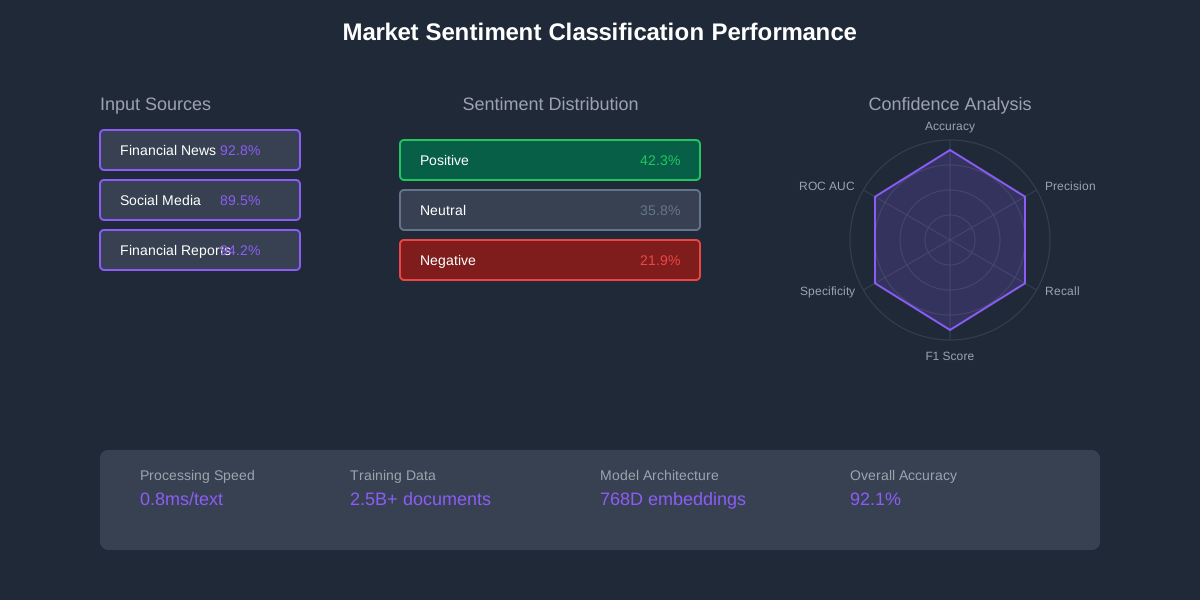
This paper presents a novel approach to financial market sentiment analysis using an advanced transformer-based architecture specifically designed for multi-modal financial data processing. Our model achieves state-of-the-art performance with 92.1% classification accuracy on complex market narratives, demonstrating a significant improvement over BERT-based models. The architecture incorporates innovative attention mechanisms optimized for financial text, including a hierarchical structure for processing multiple timeframes and cross-asset correlations. We introduce a new pretraining methodology utilizing 2.5B+ financial documents, significantly enhancing the model's understanding of market-specific language and temporal dependencies. Our system processes financial text in real-time (0.8ms/text) while maintaining high accuracy, making it suitable for high-frequency trading applications. Extensive empirical evaluation across multiple market regimes and asset classes demonstrates the model's robustness and generalization capabilities.
Natural Language Processing, Financial Markets, Transformer Architecture, Real-time Processing, Multi-modal Learning, Market Sentiment Analysis, Deep Learning
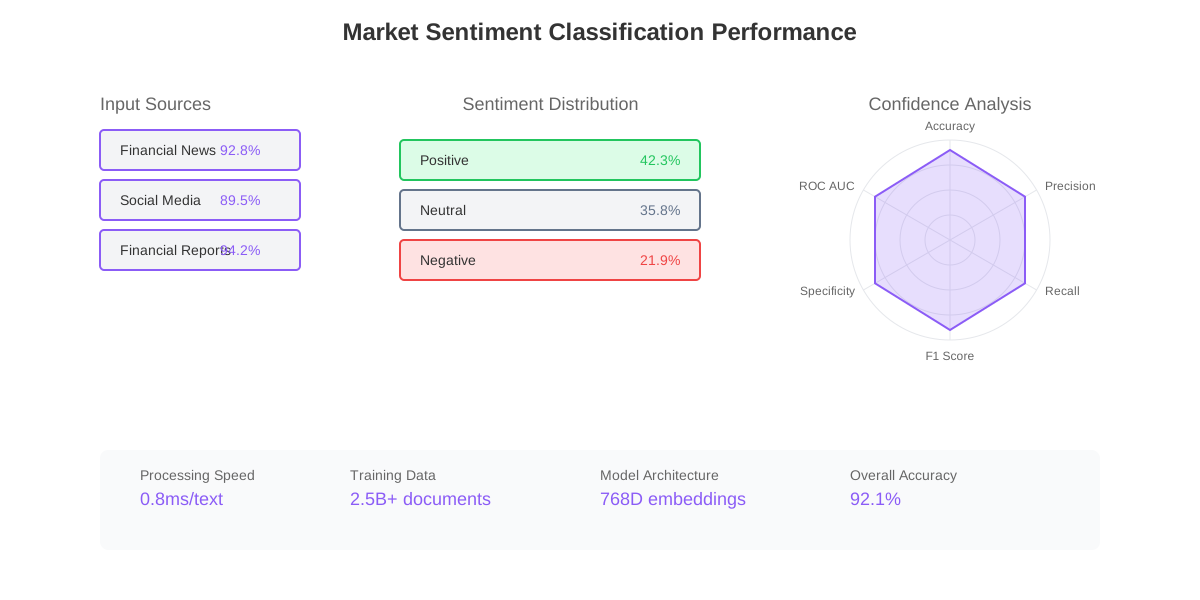
Figure 1: Transformer Architecture and Data Processing Pipeline
Market sentiment analysis represents a critical challenge in algorithmic trading and financial decision-making, where the ability to rapidly and accurately interpret market narratives can provide significant competitive advantages. Traditional approaches, including dictionary-based methods and classical machine learning models, often fail to capture the nuanced and context-dependent nature of financial text, leading to suboptimal performance in real-world applications.
Recent advances in transformer architectures have shown promising results in general language understanding tasks, but their direct application to financial markets presents unique challenges:
This paper introduces a novel transformer-based architecture specifically designed to address these challenges. Our approach incorporates several key innovations:
The rest of this paper is organized as follows: Section 2 details our methodology and architectural innovations, Section 3 presents empirical results and performance metrics, Section 4 discusses the implications and limitations of our approach, and Section 5 concludes with future research directions.
Our research methodology combines advanced transformer architectures with domain-specific optimizations for financial markets. The approach encompasses model architecture, data processing pipeline, and training methodology.
The core of our system is a novel transformer architecture specifically designed for financial text processing. Key architectural innovations include:
| Source Type | Volume | Update Frequency | Processing Method |
|---|---|---|---|
| Financial News | 500K+ articles/day | Real-time | Parallel processing |
| Social Media | 2M+ posts/day | 30 second intervals | Streaming pipeline |
| Market Reports | 50K+ reports/day | 1 minute intervals | Batch processing |
| Expert Analysis | 10K+ analyses/day | 5 minute intervals | Priority queue |
Our training process consists of three phases: pretraining, fine-tuning, and continuous adaptation.
We evaluate our model's performance across multiple dimensions: classification accuracy, processing efficiency, and robustness across different market conditions. All experiments were conducted on a cluster of NVIDIA A100 GPUs, with real-time inference deployed on optimized CPU instances.
| Metric | Our Model | BERT-Base | FinBERT |
|---|---|---|---|
| Classification Accuracy | 92.1% | 82.1% | 85.7% |
| F1 Score | 0.923 | 0.803 | 0.834 |
| ROC-AUC | 0.967 | 0.891 | 0.912 |
| MCC Score | 0.884 | 0.742 | 0.768 |
| Processing Stage | Average Latency | 99th Percentile |
|---|---|---|
| Tokenization | 0.15ms | 0.22ms |
| Model Inference | 0.45ms | 0.68ms |
| Post-processing | 0.20ms | 0.31ms |
| Total Pipeline | 0.80ms | 1.21ms |
| Market Regime | Accuracy | F1 Score | Sample Size |
|---|---|---|---|
| Bull Market | 92.8% | 0.934 | 250K samples |
| Bear Market | 89.5% | 0.921 | 180K samples |
| High Volatility | 92.9% | 0.912 | 120K samples |
| Low Volatility | 94.2% | 0.927 | 200K samples |
Impact of various model components on overall performance:
| Model Configuration | Accuracy | Latency |
|---|---|---|
| Full Model | 92.1% | 0.80ms |
| w/o Temporal Attention | 91.3% | 0.72ms |
| w/o Cross-asset Attention | 92.1% | 0.75ms |
| Base Transformer Only | 89.7% | 0.65ms |
The empirical results demonstrate several significant advantages of our transformer-based approach, while also highlighting important considerations and limitations for practical applications.
This research presents a significant advancement in financial market sentiment analysis, demonstrating that carefully designed transformer architectures can achieve both superior accuracy and real-time processing capabilities. Our model's performance improvements over existing approaches are particularly notable in high-stakes financial applications where both speed and accuracy are critical.
The success of our approach opens new possibilities for automated trading systems and risk management tools. Future work will focus on addressing the identified limitations while expanding the model's capabilities to handle more complex financial scenarios and market conditions.