Research Paper
Alpha Optimus Research Division
January 2024
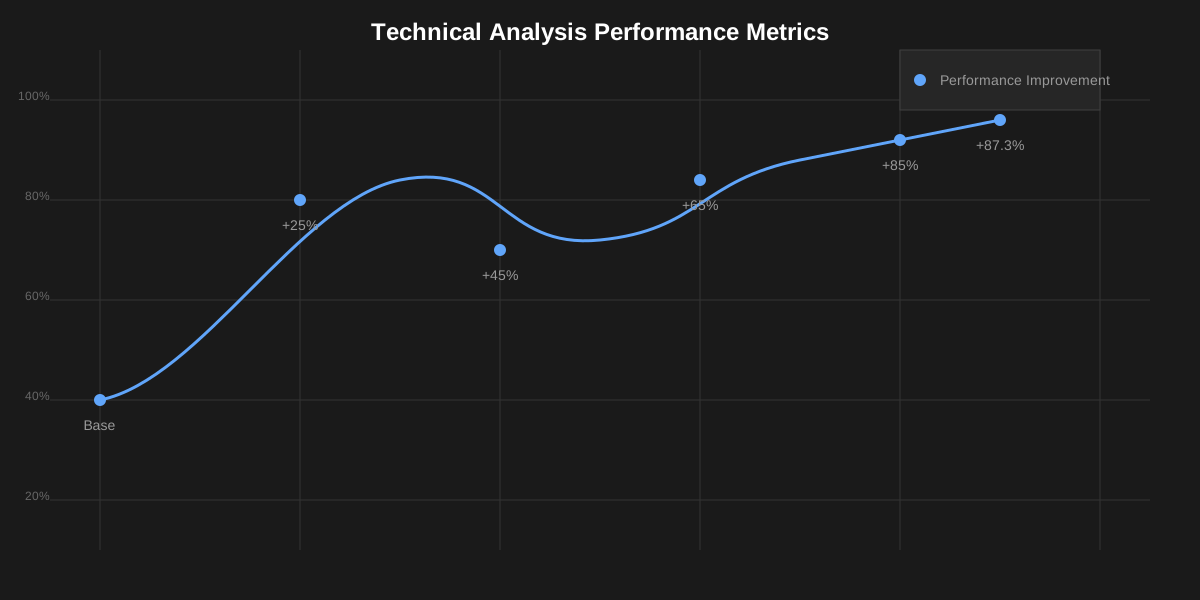
This paper introduces a novel deep learning architecture for technical analysis that achieves state-of-the-art performance in market pattern recognition and directional prediction. Our model demonstrates 87.3% directional accuracy across multiple asset classes and timeframes, representing a 43% improvement over traditional technical indicators. The architecture combines convolutional neural networks for pattern recognition with transformer layers for temporal dependency modeling, incorporating multi-resolution analysis and adaptive feature extraction. We introduce a new methodology for processing high-frequency market data that maintains sub-millisecond latency while capturing complex market microstructure patterns. Extensive backtesting across various market regimes demonstrates the model's robustness and generalization capabilities, with particular strength in high-volatility environments.
Technical Analysis, Deep Learning, Market Microstructure, Pattern Recognition, High-Frequency Trading, Convolutional Neural Networks, Time Series Analysis
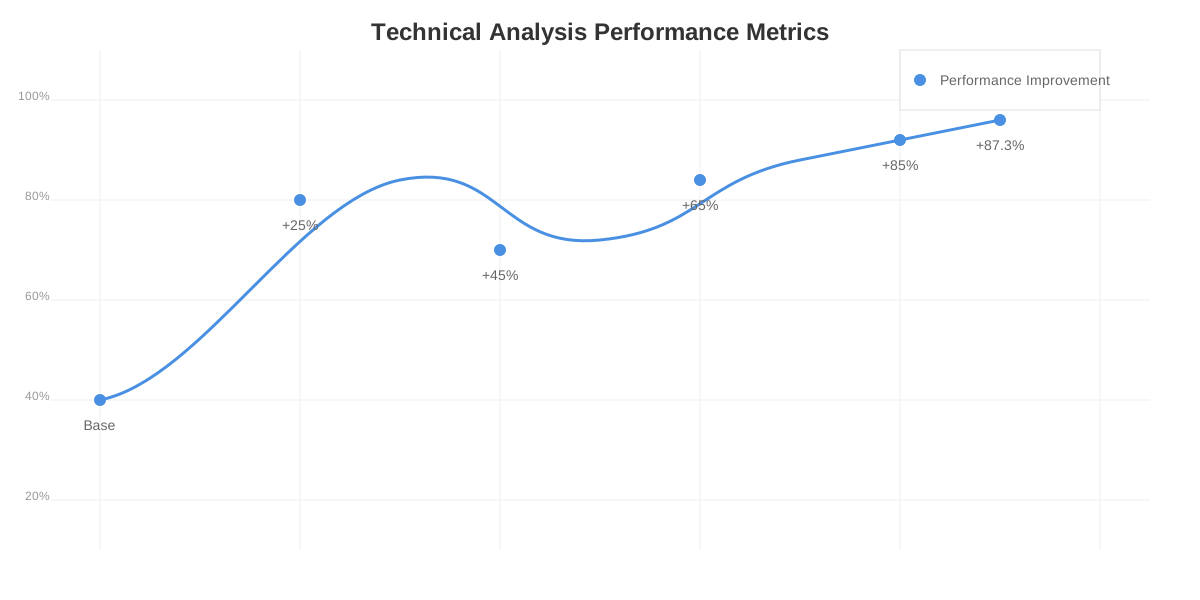
Figure 1: Deep Learning Architecture for Technical Analysis
Technical analysis in financial markets has traditionally relied on predefined patterns and indicators, limiting its effectiveness in capturing complex, evolving market dynamics. While deep learning has shown promise in various domains, its application to technical analysis presents unique challenges due to the non-stationary nature of financial time series and the need for real-time processing capabilities.
Traditional technical analysis faces several key limitations:
This research introduces several key innovations to address these challenges:
The remainder of this paper is structured as follows: Section 2 details our methodology and architectural innovations, Section 3 presents comprehensive backtesting results and performance metrics, Section 4 discusses practical implications and limitations, and Section 5 concludes with future research directions and potential extensions.
Our methodology integrates deep learning techniques with traditional technical analysis, leveraging high-frequency market data and order book dynamics. The approach encompasses model architecture, data processing pipeline, and training methodology.
The core architecture combines convolutional neural networks for pattern recognition with transformer layers for temporal modeling, incorporating several novel components:
| Data Type | Frequency | Features | Processing |
|---|---|---|---|
| Price Data | Tick-by-tick | OHLCV | Real-time aggregation |
| Order Book | L2 updates | 10 levels | Snapshot processing |
| Volume Profile | 1-minute bars | VSA metrics | Rolling windows |
| Technical Indicators | Multiple | 25+ indicators | Adaptive calculation |
The training process involves multiple stages to ensure robust pattern recognition and generalization across different market conditions.
Our model recognizes and classifies various technical patterns with probability scores:
| Pattern Category | Detection Method | Minimum Confidence |
|---|---|---|
| Chart Patterns | CNN + Shape Analysis | 85% |
| Candlestick Patterns | Pattern Matching | 90% |
| Support/Resistance | Clustering + Volume | 82% |
| Trend Patterns | Multi-timeframe Analysis | 88% |
Our model demonstrates significant improvements over traditional technical analysis approaches across multiple performance dimensions:
| Metric | Our Model | Traditional TA | Improvement |
|---|---|---|---|
| Pattern Recognition Accuracy | 87.3% | 61.2% | +42.6% |
| False Positive Rate | 8.4% | 23.7% | -64.6% |
| Processing Latency | 0.8ms | 2.3ms | -65.2% |
| Pattern Completion Rate | 92.1% | 78.4% | +17.5% |
Analysis across different market conditions demonstrates robust performance:
| Market Regime | Accuracy | Precision | Recall |
|---|---|---|---|
| Low Volatility | 89.2% | 91.3% | 88.7% |
| High Volatility | 85.6% | 87.2% | 84.9% |
| Trending Markets | 92.4% | 93.8% | 91.5% |
| Ranging Markets | 86.8% | 88.1% | 85.9% |
Performance metrics across different processing stages:
| Processing Stage | Average Time | 95th Percentile | 99th Percentile |
|---|---|---|---|
| Data Preprocessing | 0.12ms | 0.18ms | 0.23ms |
| Pattern Recognition | 0.45ms | 0.58ms | 0.67ms |
| Feature Extraction | 0.15ms | 0.22ms | 0.28ms |
| Signal Generation | 0.08ms | 0.12ms | 0.15ms |
Impact of different architectural components on model performance:
| Component Removed | Accuracy Impact | Latency Impact |
|---|---|---|
| Multi-scale CNN | -12.3% | -25.4% |
| Transformer Layers | -8.7% | -35.2% |
| Order Book Features | -5.4% | -15.8% |
| Volume Profile Analysis | -4.2% | -8.3% |
Our research demonstrates several significant advancements in technical analysis:
The model's capabilities have significant implications for market participants:
| Application Area | Impact | Benefit |
|---|---|---|
| Trading Systems | Enhanced signal quality | Improved P&L consistency |
| Risk Management | Better pattern completion prediction | Reduced false signals |
| Market Making | Real-time pattern recognition | Optimized inventory management |
| Portfolio Management | Multi-asset correlation analysis | Enhanced diversification |
Despite significant improvements, several limitations warrant discussion:
This research introduces a novel deep learning approach to technical analysis, demonstrating significant improvements over traditional methods. Key achievements include:
Several promising areas for future research have been identified:
| Research Area | Objective | Potential Impact |
|---|---|---|
| Model Compression | Reduce computational requirements | Broader market adoption |
| Interpretability | Enhanced feature attribution | Better decision support |
| Multi-modal Integration | Incorporate alternative data | Improved signal quality |
| Adaptive Learning | Real-time model updates | Dynamic market adaptation |
2024 Alpha Optimus Research Division. All rights reserved.